Related Posts Plugin for WordPress, Blogger...
Get Our Free Newsletter

Wednesday, August 17, 2011

Top Seventeen Sayings and Quotes by Marcus Mosiah Garvey

Marcus Garvey was born on August the seventeenth, and so this is a blessed day in my Journey. On this day a man was born in 1887 who would affect the way I perceive my SELF in relation to my community and my place in the world in general. Black Marcus screamed Self-identity, Self-worth, Self-reliance, Self-improvement, not just in the context of the singular person, but in the greater context of Black Community. In honor of the most Right and Honorable Marcus Mosiah Garvey's earthstrong/earthlight/earthday (birthday), I have composed this list of seventeen immensely memorable phrases, sayings and quotes from the Prophet that have influenced I, Kaya. SALUTE, Black Marcus!

17. Having had the wrong kind of education, the Negro has become his own greatest enemy.

16. The ends you serve that are selfish will take you no further than yourself but the ends you serve that are for all, in common, will take you into eternity.

15. Chance has never yet satisfied the hope of a suffering people.

14. We must canonize our own saints, create our own martyrs, and elevate to positions of fame and honor black men and women who have made their distinct contributions to our racial history. Sojourner Truth is worthy of the place of sainthood alongside of Joan of Arc; Crispus Attucks and George William Gordon are entitled to the halo of martyrdom with no less glory than that of the martyrs of any other race. Toussaint L'Ouverture's brilliancy as a soldier and statesman outshone that of a Cromwell, Napoleon and Washington; hence, he is entitled to the highest place as a hero among men. Africa has produced countless numbers of men and women, in war and in peace, whose lustre and bravery outshine that of any other people. Then why not see good and perfection in ourselves?

13. If you haven't confidence in self, you are twice defeated in the race of life. With confidence, you have won even before you have started.

12. I do not speak carelessly or recklessly but with a definite object of helping the people, especially those of my race, to know, to understand, and to realize themselves.

11. Lift up yourselves, men, take yourselves out of the mire and hitch your hopes to the very stars themselves. Let no man pull you down, let no man destroy your ambition, because man is but your companion, your equal; man is your brother; he is not your Lord, he is not your sovereign master.

10. The Mystic Touch Many years ago we fell asleep by the sedative of the superman, but the mystic magic of nature wand says awake and rise again. Too long has thou slumbered, too long has time passed you by, your work on earth is delinquent and you cannot reign on high. If it's true that you've awaken, good for you,

9. We must give up the silly idea of folding our hands and waiting on God to do everything for us.If God had intended for that, then he would not have given us a mind. Whatever you want in life, you must make up your mind to do it for yourself
  
8. Liberate the minds of men and ultimately you will liberate the bodies of men.
  
7. We Are Arbiters of Our Own Destiny. God and Nature first made us what we are, and then out of our own creative genius we make ourselves what we want to be. Follow always that great law.
  
6. Our UNION MUST KNOW NO CLIME, BOUNDARY, or NATIONALITY… PRACTICE ONE FAITH, that of Confidence in themselves, with One God! One Aim! One Destiny! Let no religious scruples, no political machination divide us.
  
5. If the white man has the idea of a white God, let him worship his God as he desires. If the yellow man's God is of his race let him worship his God as he sees fit. We, as Negroes, have found a new ideal. Whilst our God has no color, yet it is human to see everything through one's own spectacles, and since the white people have seen their God through white spectacles, we have only now started out (late though it be) to see our God through our own spectacles.The God of Isaac and the God of Jacob let Him exist for the race that believes in the God of Isaac and the God of Jacob. We Negroes believe in the God of Ethiopia…

4. I know no national boundary where the Negro is concerned. The whole world is my province until Africa is free.
  
3. Look to Africa for the crowning of a Black king; for the day of deliverance is near.
  
2. A people without the knowledge of their past history, origin and culture is like a tree without roots.
  
1. A reading man and woman is a ready man and woman, but a writing man and woman is exact.


Monday, August 8, 2011

Seeking Makeda III: (Journey in Touch)

All rights reserved for The Abeng and My Conscious Pen/
YardCore International, Inc. Publishing


Seeking Makeda III: (Journey into Touch)
copyright 2011 K.Omodele

Queen of Sheba traveling to Solomon. A fresco ...There never was a time when Queen Makeda was naught.

Anticipating caresses...
by soul-stimulating fingertips
gentle nudges from Aksumite hips
lines traced on skin; breath short, light nips
and feather-brush strokes by silken lips.

Remembering the Empress'...
whispers call, goose bumps 'pon skin,
stirring response, the conga rid-dim
heart-warmed breath like whiffs of medzItational* bliss
soaks the eardrum, arousing soul-sensational lifts

*meditational


Enhanced by Zemanta

Monday, August 1, 2011

Saluting Emancipation Day

Bless up this Emancipation Day/August Monday!
Someone special just mentioned to me that
We need some new teachers, or to evolve into the elders we are lacking/silencing. The statement is drenched in relevance- we are doing a terrible job in educating generations about our own culturally poignant history. We celebrate all manner of so-called holidays (many that are nonsensical and perpetuate lies), branding ourselves with other cultures' values and mores, while displaying little regard for our own culture and what we have overcome as a people. Jah Know!
It is I and I's (our collective) responsibility to tell ourstory, since we know history is his story and our half has hardly been told. For instance, this Tarzan-like partiality is plain when in history much praise is lauded towards the contributions of various british anti-slavery societies and organisations while relatively little importance given to the thousands of freedom fighters/slave revolts in the Caribbean region. Is full time now our story be told by us on a wider scale.

babylon release the chains...
On August 1, 1834, The Slavery Abolition Act of 1833 not-so effectively abolished slavery in the british vampire (ok, since yuh/oonu/wunna/awyuh tek offence, british Empire then). Each slave younger than six years old was "officially" declared free. But practically, this emancipation was quasi-freedom and slaves weren't actually freed until August 1, 1838.

but dem a use dem brains...
I say "not-so effectively" because if you overstand how this emancipation played out, you'd know that it wasn't like britain just let go of cheap labor without covering its arse. The jolly-good boys dem brought in a system of apprenticeship in which slaves older than six years actually worked  for four to six* more years to ensure planters would have labor and that plantation economies wouldn't belly up after emancipation. This "apprenticeship" was designed to keep slaves working eighteen hours a day on plantations in return for food, clothing and shelter while labeling them as "free".
And a next thing, millions of pounds** were given to slaveholders as compensation for losing their "property", while no money was given to slaves themselves. This systematically ensured that most ex-slaves would remain on a lower economic tier, dependent on their ex-masters for wages and livelihood.
East Indians and Chinese soon began being imported to the Caribbean as indentured servants to fill the void left after Blacks left the plantations. In many cases, these Asians would be housed in old slave quarters. 

more ourstory
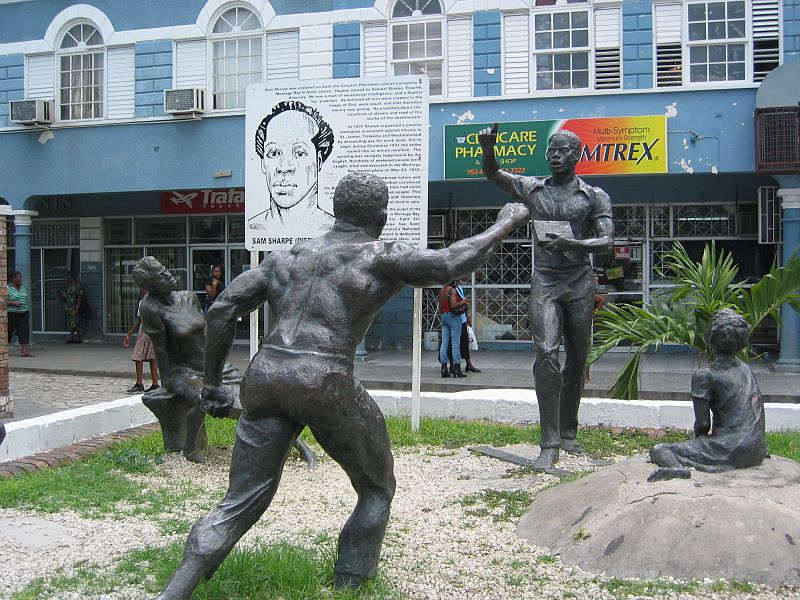
 "I would rather die in yonder gallows, than live for a minute more in slavery."~Sam 'Daddy' Sharpe
 Mek ah tell yuh, despite and in spite of the tendency of history to downplay the revolting slaves, we need to educate the masses that our freedom wasn't simply handed to a grovelling, begging people. I and I must uphold the memory of our martyrs of the African Holocaust. Throughout the region, thousands of slaves and maroons rebelled, revolted, fought and died for freedom leading up to Emancipation- Jamaica by far having the most documented rebellions. There were literally hundreds of rebellions in the West Indies. Some that have captured my imagination: The Haitian Revolution, Jamaican Maroon Wars, 1763 Revolt in Berbice (Guyana), Dominican Maroon Wars, Suriname's Maroon Wars, Tacky's Rebellion, 1733 Slave Insurrection (St. John, V.I.), Black Carib Revolts, to name a few.
In the british West Indies, though, there are three significant, large-scale rebellions that affected Emancipation that must be noted: Bussa's Rebellion (in 1816, Barbados), The Demarara Rebellion ( of 1823, Guyana), and Sam Sharpe's Christmas Uprising*** (1831, Jamaica). For sheer size and effectiveness in communicating to britain that slavery must go at any cost, they are most influential. 10,000 slaves revolted in the Demarara Rebellion and up to 20,000 in the Christmas Uprising, burning down cane fields and property, causing the equivalent of hundreds of millions of pounds in today's british currency. These three were pivotal in speeding up britain's inevitable decision.

I am appealing to writers and authors, songwriters and storytellers and wordsmiths: it is our duty to tell our story and educate the youth from our own perspectives. We cannot expect history to reflect ourstory and view point. If upcoming generations don't learn and appreci-love our collective stories and culture, we have only ourselves to blame. Especially in this age of information.


* predials, which were "field slaves", were to be apprenticed until 1940; nonpredials no later than Aug. 1, 1938 
** the total compensation paid out was £20 million which was 40% of the british government's total annual expenditure
***AKA the Baptist War, Sam Sharpe's Rebellion, and The Great Jamaican Slave Revolt


These countries observe August 1 Emancipation Day

  • Saint Lucia
  • Barbados: Emancipation Day in Barbados is part of the annual "Season of Emancipation" which runs from April 14 to August 23. The Season, includes the anniversary of the Slave Rebellion led by the Right Excellent Bussa, National hero, in 1816 , National Heroes Day on April 28, the Crop Over Festival,the Day of National Significance on July 26(in commemoration of the social unrest of 1937)and International Day for the Remembrance of the Slave Trade and its Abolition on August 23. Emancipation Day celebrations usually feature a Walk from Independence Square in Bridgetown to the Heritage Village at the Crop Over Bridgetown Market on the Spring Garden Highway. At the Heritage Village, apart from a concert, there is also a wreath-laying ceremony as a tribute to the ancestors. Traditionally, the Prime Minister, the Minister responsible for Culture and representatives of the Commission for Pan African Affairs are among those laying wreaths.
  • Bermuda: Celebration usually occurs on August 2, despite August 1 being the national holiday. On the island the holiday is better known as the first day of "Cupmatch", an annual two-day cricket competition between the St. George's and Somerset cricket clubs.
  • Guyana
  • Jamaica
  • Saint Vincent and the Grenadines
  • Trinidad and Tobago
  • Turks and Caicos Islands

These countries observe Emancipation Day the first Monday as August Monday

  • Anguilla: In addition to commemorating emancipation, it is the first day of "August Week", the Anguillian Carnival celebrations. J'ouvert is celebrated on this morning, as Carnival commences.
  • The Bahamas: Celebrations are mainly concentrated in Fox Hill Village, Nassau, a former slave village whose inhabitants, according to folklore, heard about their freedom a week after everyone else on the island. There is a also a celebration beginning on August 1 and lasting several days held in the charming settlement of Hatchet Bay on the Bahamian island of Eleuthera known as the Bay Fest.
  • British Virgin Islands: The first Monday, Tuesday, and Wednesday of August are celebrated as "August Festival".
  • Saint Kitts and Nevis: The first Monday and Tuesday are celebrated as "Emancipation Day" and also Carnival in Nevis.


Enhanced by Zemanta

Friday, July 15, 2011

Silent Violence


Silent Violence
by Kaya Omodele 11-15-07

Lonely bird in a cage croons longingly
Day by day his tune sours, dims to a wail
Until one night his heart bleeds of silence

Caged and draped in only a muffled wail
Shivering, wings fractured, hauntingly silent
Languishes… Laments…Sighs longingly

One final breath, discomforting silence
Peaceful now? Finally, no more wailing?
No pain? Sorrows dry? No further longing?

Forget singing; I know why a caged bird
wails. Silence is Violence.
Copyright K. Omodele 2007
Enhanced by Zemanta

Monday, July 11, 2011

Spoken Word Griots: African Oral Tradition in Caribbean Music (Second Part)


In Africa, oral tradition was the primary means of teaching a people's history and culture. Griots were adept  storytellers, teachers and historians. African music was almost always pragmatic and functional-it did something. From keeping timing to farmers wielding their tools to announcing a birth. So integrating the spoken word and music was steeped in oral tradition practicality.

African oral tradition survived the slave ship and thrived in spite and despite the institution of slavery. As a matter of fact, slave holders' codes that prohibited slave literacy worked in the favor of oral tradition as Africans continued to rely on storytelling and spoken word as a way of teaching family/community history, morals and brought-up-cy (values). Throughout the Caribbean, African oral tradition was kept alive in stories like Br'er Anansi*, in Africanized/African-themed proverbs, and folk tales and songs.  Cultural knowledge and values were passed through word of mouth from generation to generation, reinforcing family, community and clan. This is most evident in speech and customs still found in maroon communities throughout the Caribbean today.

That African oral tradition exists in Caribbean music is undeniable, especially when recalling components and characteristics that define African music: functionality, audience participation, its ability to relate and preserve culture through storytelling. Elements of oral tradition that are readily identified include the call and response melodies in Caribbean folk songs like "Day-O", which is a Jamaican mento song originally sang by dock workers loading bananas on ships. A few examples of Caribbean music that display oral tradition: Calypso, mento, pocomania and zouk. 

* the word Anansi in Akan means spider


Enhanced by Zemanta

Saturday, July 2, 2011

Exonerate The Right and Honorable Marcus Mosiah Garvey


“Emancipate yourself from mental slavery, none but ourselves can free our mind.” - Marcus Garvey

The statement above reverberates the mantra of self liberation with such absolute instruction that Bob Marley quoted it in Redemption Song. It is a command to seek knowledge of self; to learn collective self dignity; to find purpose and design destiny at a time when the African-diaspora was still referred to as Negro, which is the Spanish word for black. It is the instruction of a prophet, no doubt, a trumpet sound, the sound of an abeng. It is a message that is as relevant today as it was in the 1920's.

It is a poignant decree whether read in university or penitentiary. Whether Rasta or Muslim or Hebrew- Israelite or Christian or even if your call goes out to Shango. Whatever the culture, region or class, Marcus' statement knew "no national boundary where the Negro is concerned."

Now just in case you ain't nevah hear, Marcus Garvey was convicted of trumped up charges in an attempt to derail the strides he was making in the world-wide liberation of  Black masses. (Yes I said trumped up because that's what the hell they were. And if you want learn more bout the trial, if yuh nevah read it before, go check di bredren Geoffrey Philp who has summarized the whole travesty) The point is that in this day and time, we cannot allow this injustice to carry on longer.

“Until lions have their historians, tales of the hunt shall always glorify the hunter”-African Proverb
We need to rewrite history when we know it has intentionally muddled ourstory, wrongfully belittled our leaders. So join in petitioning Barack Obama to clear the name of Marcus Mosiah Garvey.

Just a few of Marcus' contributions in the struggle for liberation:
    The red, black and green flag was created by t...                                  Image via Wikipedia
  • UNIA- founder of the Universal Negro Improvement Association which at one time boasted up to 5 million members in hundreds of chapters world wide (Cuba had couple dozen)
  • The Flag- the Red, Black, Green
  • The Black Star Line- fleet of ships
  • Media like Negro World which at the time was the largest circulated Black weekly newspaper
  • set blue print/model for vertical integration and cooperative economics for Black businesses
  • championed the Pan-Africanism cry
Some of Marcus Garvey's utterances that have influenced us:
  • "One Aim; One God; One Destiny."
  • "A people without the knowledge of their past history, origin and culture is like a tree without roots." 
  • "Up, you mighty race, accomplish what you will." 
  • "Africa for the Africans... at home and abroad!" 
  • "Liberate the minds of men and ultimately you will liberate the bodies of men." 
  • "Chance has never yet satisfied the hope of a suffering people."
Some of our leaders who were influenced by Garvey:
  • Kwame Nkrumah
  • Sekou Ture
  • Malcolm X
  • Kwame Ture/Stokely Carmichael
  • Nyerere
  • Patrice Lumumba
  • Walter Rodney
  • Noble Drew Ali
  • Jomo Kenyatta
Now one thing The Abeng and My  Conscious Pen wants to make perfectly clear is that while I support the cause of Garvey's name being cleared of any criminal wrongdoing, I do not feel we as The People need to be grovelling or making apologies for him. Garvey was a freedom fighter like Sam Sharpe, Cuffy, Zumbi dos Palmares and held as a political prisoner in the same manner as Mandela, Toussaint L'Ouverture, Geronimo. I don't care how others see Marcus, I and I hold him in greatest regards.


    Here is the Petition http://signon.org/sign/clear-marcus-garveys?source=c.fb&r_by=217693


    Monday, June 13, 2011

    Brother Wally: Walter Rodney's Groundings With My Brothers

    "We must understand that we are still locked in struggle. And 
    we are reaffirming our commitment to struggle, and we are
    saying we are ready to proceed. We are moving forward, we are
    not intimidated, we recognize the pressures, but we are far
    from bending under those pressures." 
    -- Walter Rodney, June
    6, 1980, Georgetown, Guyana


    In Groundings With My Brothers, Walter Rodney called Rastafari bredren, "the leading force of the expression of black consciousness in the Caribbean."  In an introduction to the work, Richard Small reflected on how fast in the 1970s the young Guyanese-born scholar had gained popularity in Jamaica and in the entire Caribbean as "the man who knew about Africa ... and who would talk to anybody who wanted to hear him ..." 
    Although a well-respected professor of African Studies at the University of The West Indies at that time, Dr. Rodney preferred grass roots reasonings with Rasta and poor people in Kingston rather than mixing and mingling with socialites at the university.


    "There is no continuity in my life in respect of old acquaintances. We meet;I try to be pleasant; and I move on. For our generation too is adding its quota to the frightening sterility of the society. Living off campus is a great boon, for it reduces my contact with rum-sipping soul selling intellectuals of Mona..." 


    Having come from a modest background in Georgetown, Guyana,  he emphasized the need for Black intellectuals to attach themselves to the plight of the masses.
      
    "I would go further down into West Kingston and I would speak wherever there was a possibility of our getting together. It might be in a sports club, it might be in a schoolroom, it might be in a church, it might be in a gully. (Those of you who come from Jamaica know those gully corners.) They are dark, dismal places with a black population who have had to seek refuge there. You will have to go there if you want to talk to them. I have spoken in what people call ‘dungle’, rubbish dumps, for that is where people live in Jamaica. People live in rubbish dumps."

    “The first essential was to operate outside of the petty bourgeois University campus and outside of the 'respectable' middle class suburb where I resided. My background in Guyana was working class, but after the alienation produced by the educational system, it was up to me to retake the initiative to rediscover my brothers and sisters. I sought them out where they lived, worked, worshiped, and had their recreation. In turn they 'checked' me at work or at home, and together we 'probed' here and there, learning to recognize our common humanity. Naturally they wanted to know what I stood for, what I ‘defended’. I never gave anyone money or bought them drinks; that one must leave to the political gangsters’ of the two-party system. At some point I ceased to be Dr Rodney and was addressed as 'Brother Rodney' or better still ‘Brother Wally’ That simple change meant I was no longer a tool of the establishment, but was readmitted into the moral and cultural brotherhood of the Black man.”

    "So long as there are people who deny our humanity as blacks, then for so long must we proclaim and assert our humanity as blacks. That is why our historical and cultural heritage is so important, and that is why we must proceed to live our culture because culture is a way of life. We must recover what was taken away from us and we must adapt in order to survive and keep on growing as a section of humanity."


    Note~ Groundings/reasonings are communal discussions,lectures or exchanging of ideas, information and opinions


    More on Dr. Walter Rodney
    Methodmecca.com: Who is Walter 
    Roots and Culture Media
    The Signifyin' Woman (Charmaine Valere) 
    A June 13th Tribute: Walter Rodney, the Rastafari and dungles’ everywhere


    Wednesday, June 8, 2011

    Seeking Makeda II: (Journey InSight)

    Seeking Makeda II: (Journey InSight)
    copyright 2011 K. Omodele

    (Empress Makeda...)

    Skin glistening like a rippling river's dark sheen
    eyes glittering, dancing- two black diamonds gleam
    nose gently-molded, rounded from Iteru's* clay
    plum-passion lips kissed silt scooped from Ṭiqūr ʿĀbbāy**
    Makeda's smile illuminates as moon-bright beams
    reflecting Lake Tana*** deep in Nubian Queens


    *the KMT (ancient Egypt) name for the Nile River 
    ** Ethiopian name for The Blue Nile (Ge'ez  ጥቁር ዓባይ; Ṭiqūr ʿĀbbāy is literally Black Abbay)
    ***source of the Blue Nile (location Ethiopian Highlands)

    copyright 2011 K. Omodele


    Found on
    http://weheartit.com:8080/tag/dark%20skin

    Found on
    http://www.warwicksaint.com/photographer/gallery


    Enhanced by Zemanta
    Related Posts Plugin for WordPress, Blogger...

    Featured Post

    Spoken Word Griots: African Oral Tradition in Caribbean Music (Third Part) - Calypso

    Spoken Word Griots: African Oral Tradition in Caribbean Music (Third Part) - #Calypso by K. Omodele African traditions and customs are i...

    Popular Posts