Related Posts Plugin for WordPress, Blogger...
Get Our Free Newsletter
Showing posts with label West Indies. Show all posts

Tuesday, March 1, 2016

WHY A BOOK IS A GREAT GIFT FOR A CHILD

                            Give A Child A Book! Reading Lights An Imagination
                                        by K. Omodele @TheAbeng

"Read! Read! Read! and never stop until you discover the knowledge of the Universe!" ~ Marcus Garvey, instructing an audience in St. Kitts, British West Indies in 1937

I'll never forget the first book I ever read on my own from cover to cover- The Red Brigade. I was six and I read page after page for what seemed like the whole day; but, when I closed it, I felt big- bigger than my suck-a-finger self, bigger than dunking my butter bread in my tea, big like my mother's good-good school friend with the pretty, wide eyes, who used to pick me up and hug me up tight, but no more because now I could help her read all them heavy school books she had and maybe even get married because now I had read about it, she was sure to invite me to her socialist party.

The next book I remember reading was The Little Man, another children's book, about a slave boy that tore from plantation to plantation spreading news that the slaves were uprising. I was fascinated by the adventure of the insurrection; the graphics and descriptions of the pounding of the drums fixed my mind on the hand-crafted drum my beloved Auntie gifted my older cousins and me. The carved and chiseled wood, the stretched-tight goat skin over the head of the drum resembled the drawings in the book. How old could the drum be?

From then on, I patted the drum faster, pounded it harder, sprinting mile after mile, from plantation to plantation, rebelling. "Rise up! Burn down de cane fields!"

A book is a precious gift for a child. It can spark the imagination, ignite creativity and transport a young mind to intriguing places and times. A book can be more life impacting than a pair of Jordan's and leave longer-lasting impressions than a Polo shirt. Gifting a child a book sends a life message: reading must be valued; knowledge is better than silver and gold.

Monday, February 15, 2016

Black History: The Haitian Revolution (The Revolt That Birthed a Nation-Part I)

  Black History: The Haitian Revolution (The Revolt That Birthed a Nation-Part I)
                                          by K. Omodele 2016 @TheAbeng

Introduction- Slave Revolts In the African Diaspora
There have been hundreds of slave revolts in the history of the African Trans-Atlantic slave trade. Africans resisted captivity in slave forts, on ships and plantations. In St. John and Guyana, slaves took over whole colonies, tasting freedom temporarily, before being re-conquered and re-enslaved.* Maroons in Jamaica, Surinam and Brazil, and Black Caribs in St. Vincent, fought colonial masters and militias to establish independent/sovereign societies that existed autonomously within individual slave colonies. However, the slave insurrection that is distinctive in achieving an ultimate level of success (freeing the whole slave colony AND forming an independent nation) is the epic Haitian Revolution.

"The revolution is made by ordinary people, not by angels, made by people from all walks of life." ~ Dr. Walter Rodney

The Haitian Revolution was the most successful slave revolt in the history of the so-called New World (i.e. The Western Hemisphere). This revolution significantly affected dynamics in the histories of the West Indies, both Americas, the African Diaspora and Europe. Its events gradually formed a nation, but the revolution's leaders didn't learn their tactics in military academies studying the art of war or political science; nor were they propagating a new economic system or faith. These revolutionaries emerged off fields and fled plantations, first brandishing cutlasses, machetes, hoes and fire; then, with guns, cannons, more fire and cries of freedom, they executed revolts that became a revolutionary war that gave birth to Haiti** - the second independent republic in the Americas and the first nation formed by former African slaves.

Saint Domingue In The 1700s
In 1697, Spain ceded the Western third of Hispaniola to France. The Spanish called their colony Santo Domingo, the French called theirs Saint Domingue. In the 1700s, Saint Domingue was the most prosperous colony in the world and the richest in the entire French Empire. Africans slaved on highly profitable plantations where sugar was the chief crop, but others included tobacco, coffee, cocoa, indigo and cotton. By the end of the century, estimates have the population in Saint Domingue at:

-  30-40,000 Frenchmen (grand blancs and petit blancs)
-  22-27,000 Mulattoes and free Blacks (gens de coleur)
-  500,000+  Black/African slaves

"Nowhere in the West Indies in 1789 was there a greater hell on earth than the French Colony of Saint Domingue..." ~ Dr. Eric Williams
These various classes/castes within the society resented, often despised, each other. Being outnumbered over 10 to one, the Frenchmen, the plantation owners, were constantly on edge to hold on to the balance of power and so kept their African slaves in line by brutalizing them for slight offenses and beheading and racking them for insubordination. But these Whites themselves were divided by class: the grand blancs were the planters and merchants, while the petit blancs were the lower-class workers and laborers.
The Mulattoes and free Blacks had the right to own property but resented the fact that they had little or no legal rights.
Of course, slaves had no rights and so they despised the other classes.

*some leaders and members of these rebellions committed suicide rather than be taken alive and forced back into slavery.
** Haiti ~ Ayti was the Taino Arawak name for the island Columbus "claimed" for Spain, calling it Hispaniola (present-day Haiti and the Dominican Republic. Ayti ,means "Land of high mountains"

The Haitian Revolution Part 2 - Leaders of the revolution: Boukman, Touissant, Dessalines, Christophe, et.al.

References:
Fick, Carolyn E. The Making of Haiti: The Revolution from Below. Knoxville, Tenn., 1990.
James, C.L.R. The Black Jacobins: Touissant L'Ouverture and the San Domingo Revolution. 1938. Reprint. New York, 1963.
Williams, Eric. From Columbus to Castro- the History of The Caribbean 1492-1969
Williams, Eric. History of the People of Trinidad and Tobago. Reprint.

Wednesday, September 16, 2015

Caribbean Short Story: Mother To Son (of Comrades and Thieves)

              Caribbean Short Story: Mother To Son (Comrades and Thieves)
                                    copyright 2015 K. Omodele
The evening before he was to march in the Cooperative Republic's Youth Mass Games, a mother ironed her son's newer, khaki school pants as the boy buttered his supper bread. They lived in a 'big yard' with three other board houses, each divided into apartments. While the sun ducked below the tropical skyline of zinc* roofs, coconut and mango trees, the mother lowered her voice and told her ten-year-old son:
"This whole Mass Games business is some play-play, Mao Zedong - Red Brigade type a thing." She squared her eyes sternly on the ironing board; shook her head. "Only thing, our youth have black and brown faces and West Indian lingo.**"
Giving his lemongrass tea time to cool, the boy gobbled a mouthful of butter bread, half-listening to his mother. His shoulders ached and his wrists were a 'lil bit sore from lashing sixes and hooking fours during recess earlier that day.
"Oh, an' the Prime Minister, Comrade Leader, preachin' socialism an' robbin' the country blind, same time." She ironed with smooth but forceful strokes like Clive Lloyd defending the wicket.

Wrapping her words with hushed tones, she reminded him. "You see how they lock up yuh Uncle and your Auntie?" Knotted her speech with short strings of grumbling. "And for what? Eh? Talkin' his mind and tellin' de truth?"
Life in the yard was like mackerel in a tin; always bent her up whenever neighbors got loud and made their quarrels everybody-in-the-yard's business. She'd shrill out in her little, fine voice. "Man, why yuh big an' brawlin' so? You don't have no broughtupcy*** or what?"
But this evening her whispering didn't wear no gown of decency, no; it was fashioned in the fact that subversive talk might drift through spaces between shanty wall-boards and be carried off as conspiracies, way-far beyond the tenement yard.
Her son sipped his tea and she held her breath- it might burn him. When it didn't, she carried on.
"I have a good mind keep you home tomorrow, yuh hear? No Mass Games. No marchin'. No nothin'"

He sipped the tea. It wanted more sugar but she had done stirred in two spoons already- she might flip. He stole a glance. She wasn't looking, just set the iron upright.
"But if you don't march, they goin' kick you out the school? They wouldn't do that, would they? Before you take Common Entrance?"**** She turned her back and draped his school pants neatly over the wobbly-legged Berbice chair.
Quicker than a wharf-rat, he snuck another heaping spoonful from the sugar tin, dumped and swirled.

She threaded a needle. Knotted the thread and took up is clothes-line dried school shirt. "People at the plant done sayin' how the Opposition too damn ungrateful." She placed a new-bought school crest over the shirt pocket, where she'd removed the worn-out one, and began stitching. "'Bout how, if it wasn't for Comrade Leader we might still be using Pound an' Shilling. And how if the government lock up all a we Alliance backside up, it would a serve we Rodney-rass right."
She bored and pulled as she spoke- face tense. Gored and pulled.
"You finish?" She asked, getting up. She came over to her son calmly.
He nodded. Pushed back his chair, plate empty.
She shot him a stinging box***** across his shoulder. "Think I didn't see you thief more sugar behind me back?"

*corrugated tin sheets
** Caribbean dialect
*** good behavior; wasn't brought up (raised) with good ways
**** a placement exam to leave primary school and enter high school; taken by students throughout the former British West Indies

___________________________________________end___________________

Monday, August 17, 2015

A Birthday Letter to Marcus Garvey

                                                  Earthday Letter to Marcus
                                                  Copyright 2015 K. Omodele

Most Right and Honorable Marcus Mosiah,
Greetings I bring on your 128th Earthstrong*. May the Most High, Jah, shower you infinitely with eternal blessings. Your message has lived on and your impact on the lives of millions all over the Earth illustrates brightly that word - sound is power. Before you ascended, humbly, seventy-five years ago, you told us we could find you in the whirlwinds...Some of us may have wondered whether waves of time might wash away your gigantic footprint.

Emphatically I say, this is not so. Many of us have not forgotten, will never forget. History strung up a lynching but ourstory absolves you. We, the People, trumpet your sound through the ages- even this one of information. Avenues and schools, world-wide, bear your name. We write and sing songs about you; read and write books that convey your story- ourstory (you said we should uplift and celebrate our own heroes). Marcus Mosiah, in Ghana (the former Gold Coast) the flag and the national football team are called the Black Star**; in Jamaica you are the first National Hero; in Rasta you are Prophet, complementing Priest and King.

We herald the principles for which you stood on-square. You uplift us still, inspiring us to see in ourselves the image of God. You shouted that there's nothing the mind can imagine that man cannot accomplish- did you ever imagine the U.S. could elect a Black president, one with an African name at that? And now there's an African Union, but Jah knows we could use your leadership there. Oh, did you see your beloved West Indies when we tried the Federation? Petty minds got in our way but you done already know how that goes. Now Caricom is our feeble response to your call for regional unity.

It's not an easy road we've travelled and we still have a mighty long way to go. But rest assured, Ababa Mose, your sons and daughters stand firm, work proud, walk with our heads high; as we trod Jah Earth your spirits breathes within us. Have a most blessed earthday.

Sincerely,
Kaya Omodele

Monday, August 1, 2011

Saluting Emancipation Day

Bless up this Emancipation Day/August Monday!
Someone special just mentioned to me that
We need some new teachers, or to evolve into the elders we are lacking/silencing. The statement is drenched in relevance- we are doing a terrible job in educating generations about our own culturally poignant history. We celebrate all manner of so-called holidays (many that are nonsensical and perpetuate lies), branding ourselves with other cultures' values and mores, while displaying little regard for our own culture and what we have overcome as a people. Jah Know!
It is I and I's (our collective) responsibility to tell ourstory, since we know history is his story and our half has hardly been told. For instance, this Tarzan-like partiality is plain when in history much praise is lauded towards the contributions of various british anti-slavery societies and organisations while relatively little importance given to the thousands of freedom fighters/slave revolts in the Caribbean region. Is full time now our story be told by us on a wider scale.

babylon release the chains...
On August 1, 1834, The Slavery Abolition Act of 1833 not-so effectively abolished slavery in the british vampire (ok, since yuh/oonu/wunna/awyuh tek offence, british Empire then). Each slave younger than six years old was "officially" declared free. But practically, this emancipation was quasi-freedom and slaves weren't actually freed until August 1, 1838.

but dem a use dem brains...
I say "not-so effectively" because if you overstand how this emancipation played out, you'd know that it wasn't like britain just let go of cheap labor without covering its arse. The jolly-good boys dem brought in a system of apprenticeship in which slaves older than six years actually worked  for four to six* more years to ensure planters would have labor and that plantation economies wouldn't belly up after emancipation. This "apprenticeship" was designed to keep slaves working eighteen hours a day on plantations in return for food, clothing and shelter while labeling them as "free".
And a next thing, millions of pounds** were given to slaveholders as compensation for losing their "property", while no money was given to slaves themselves. This systematically ensured that most ex-slaves would remain on a lower economic tier, dependent on their ex-masters for wages and livelihood.
East Indians and Chinese soon began being imported to the Caribbean as indentured servants to fill the void left after Blacks left the plantations. In many cases, these Asians would be housed in old slave quarters. 

more ourstory
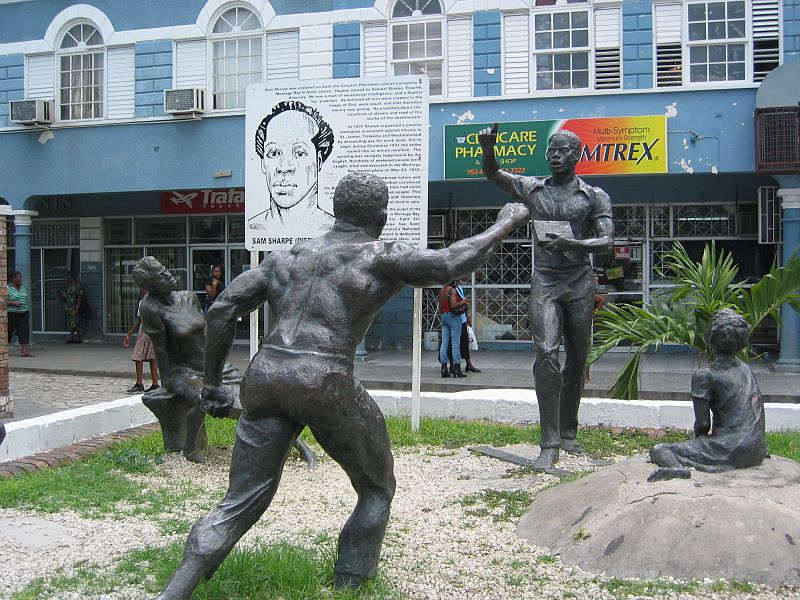
 "I would rather die in yonder gallows, than live for a minute more in slavery."~Sam 'Daddy' Sharpe
 Mek ah tell yuh, despite and in spite of the tendency of history to downplay the revolting slaves, we need to educate the masses that our freedom wasn't simply handed to a grovelling, begging people. I and I must uphold the memory of our martyrs of the African Holocaust. Throughout the region, thousands of slaves and maroons rebelled, revolted, fought and died for freedom leading up to Emancipation- Jamaica by far having the most documented rebellions. There were literally hundreds of rebellions in the West Indies. Some that have captured my imagination: The Haitian Revolution, Jamaican Maroon Wars, 1763 Revolt in Berbice (Guyana), Dominican Maroon Wars, Suriname's Maroon Wars, Tacky's Rebellion, 1733 Slave Insurrection (St. John, V.I.), Black Carib Revolts, to name a few.
In the british West Indies, though, there are three significant, large-scale rebellions that affected Emancipation that must be noted: Bussa's Rebellion (in 1816, Barbados), The Demarara Rebellion ( of 1823, Guyana), and Sam Sharpe's Christmas Uprising*** (1831, Jamaica). For sheer size and effectiveness in communicating to britain that slavery must go at any cost, they are most influential. 10,000 slaves revolted in the Demarara Rebellion and up to 20,000 in the Christmas Uprising, burning down cane fields and property, causing the equivalent of hundreds of millions of pounds in today's british currency. These three were pivotal in speeding up britain's inevitable decision.

I am appealing to writers and authors, songwriters and storytellers and wordsmiths: it is our duty to tell our story and educate the youth from our own perspectives. We cannot expect history to reflect ourstory and view point. If upcoming generations don't learn and appreci-love our collective stories and culture, we have only ourselves to blame. Especially in this age of information.


* predials, which were "field slaves", were to be apprenticed until 1940; nonpredials no later than Aug. 1, 1938 
** the total compensation paid out was £20 million which was 40% of the british government's total annual expenditure
***AKA the Baptist War, Sam Sharpe's Rebellion, and The Great Jamaican Slave Revolt


These countries observe August 1 Emancipation Day

  • Saint Lucia
  • Barbados: Emancipation Day in Barbados is part of the annual "Season of Emancipation" which runs from April 14 to August 23. The Season, includes the anniversary of the Slave Rebellion led by the Right Excellent Bussa, National hero, in 1816 , National Heroes Day on April 28, the Crop Over Festival,the Day of National Significance on July 26(in commemoration of the social unrest of 1937)and International Day for the Remembrance of the Slave Trade and its Abolition on August 23. Emancipation Day celebrations usually feature a Walk from Independence Square in Bridgetown to the Heritage Village at the Crop Over Bridgetown Market on the Spring Garden Highway. At the Heritage Village, apart from a concert, there is also a wreath-laying ceremony as a tribute to the ancestors. Traditionally, the Prime Minister, the Minister responsible for Culture and representatives of the Commission for Pan African Affairs are among those laying wreaths.
  • Bermuda: Celebration usually occurs on August 2, despite August 1 being the national holiday. On the island the holiday is better known as the first day of "Cupmatch", an annual two-day cricket competition between the St. George's and Somerset cricket clubs.
  • Guyana
  • Jamaica
  • Saint Vincent and the Grenadines
  • Trinidad and Tobago
  • Turks and Caicos Islands

These countries observe Emancipation Day the first Monday as August Monday

  • Anguilla: In addition to commemorating emancipation, it is the first day of "August Week", the Anguillian Carnival celebrations. J'ouvert is celebrated on this morning, as Carnival commences.
  • The Bahamas: Celebrations are mainly concentrated in Fox Hill Village, Nassau, a former slave village whose inhabitants, according to folklore, heard about their freedom a week after everyone else on the island. There is a also a celebration beginning on August 1 and lasting several days held in the charming settlement of Hatchet Bay on the Bahamian island of Eleuthera known as the Bay Fest.
  • British Virgin Islands: The first Monday, Tuesday, and Wednesday of August are celebrated as "August Festival".
  • Saint Kitts and Nevis: The first Monday and Tuesday are celebrated as "Emancipation Day" and also Carnival in Nevis.


Enhanced by Zemanta

Tuesday, April 27, 2010

Mother To Son


copyright 2010 K. Omodele

trademark The Abeng/Yardcore International, Inc.
A frustrated mother says to her eleven year-old son:
"Son, know this: a farmer don’t just plant, so. Is a long, drawn out process to grow good crop- it don’t just happen -BUDUPS- outta de blue, it tek (takes) work and diligence.

First, you as the farmer must burn down all trees and bush over de land. Then, after that, till the earth-and that mean turn it over wid a big fork or machine and make up some beds of soil. Then yuh have to prepare and fertilize the soil with manure and dung, which in itself is a bitch ‘ca (because) it stink so to high heaven. Is a shitty task, Son, but essential beca good crop don’t grow in unfertile soil. And if not manure then compost, which can be dead fish head and banana peel, orange peel anything so.

So now after that, when you as de farmer done prepare the soil, tek yuh seed and plant dem in a drum, pan or can or something so. When they sprout up, yuh nurture dem into seedlings. After the seedling dem catch, den yuh transplant dem into the soil beds and then the real nurturing and nourishing start- water, preening, all dem type a thing. You can’t just expect them fi grow so- wild weed will come and choke dem. So you must keep weeding out bad growth from round dem as the grow. And after all that, you might get a good crop and not bad breed.

So, Son, yuh see how much preparation and work and care go into planting a good crop? GOOD! Then is the same thing when you want find a woman and plant a seed in her… yuh cyaan (can’t) just fling good seed in any soil so. You must tek time and mek sure her soil well nourishing, meaning that she will nurture yuh seed when it grow. Take yuh time! And, Son, careful: some soil wha look rich might be poison! So, watch and mind how yuh flinging yuh seed!

One more thing…pay attention, Pickney! Whenever you do go plant a seed, be like the
good farmer; meaning, TEK CARE MIND IT WHILE IT GROW!"


copyright 2010 K. Omodele


Enhanced by Zemanta

Thursday, November 12, 2009

The Under The Mango Tree


©2009 K.Omodele
In Nineteen Eighty, poor people couldn’t stop talking bout young Natty Fidel and the newspapers couldn’t stop writing about him. The capital city was a barrel of gun powder with a slow-burning fuse, and the people of the city squeezed their eyes tight and corked their ears.
The Under The Mango Tree was little more than four gray, cinderblock walls, with a fifty-five gallon drum grill planted outside the back door. Inside was a vinyl covered bar counter with a sink behind it. In one corner, a beatup jukebox offered 45’s, selections from an era that had slipped away-the time of Desmond Dekker, Sam Cook, and The Mighty Sparrow. Overhead, a bare forty-watt bulb with a pull chain hung precariously, a threatening hangman’s noose.
A ruby glow snaked from behind the counter where the owner was bent over stocking the freezer chest with beer and stout and Malta. She pretended to ignore the two plain-clothes regulars huddled at a table by the juke box. She was a single mother of two and still attractive in her early forties. Her hands and feet were calloused and her heart tattered by pieces of shattered dreams.

Mid-day approached and she methodically prepared for the after-work, happy hours. Friday evenings were typically her busiest. The bar was a skip and jump from the city’s East-side police station and so it was like an officers' clubhouse. And so, in the surrounding ghettos it was known as the “Babylon Bar”.
Rising from the freezer, the owner wiped her hands on her apron and scooped up two plastic containers on the way out the back door. A minute later, spices dripping on embers sizzled and popped. Roast fish aroma wound through the door tantalizing the two men drinking at their table.
“Ms. Lorna,” shouted the older one-the detective sergeant. “I telling you, your hand coulda resurrect Christ. I need two piece a fish.”
“Coming deh, Mr. Pruitt.” This one was a killer, f’real. He was manatee large and deliberate in his movement. When he explained things, his voice was bogged in impatience.
Ms. Lorna scurried back outside and in few seconds flashed back behind the counter with two fire-hot fish in brown paper.
“And bring a next round,” the younger detective added, waving a long arm. He was a light post with a razor-bumped face.
Miss Lorna answered. “No problem!” and threw a pan of ice in the sink behind the counter. She ice-picked it and fixed two more rum and coconut water. Tossed a splinter of ice in her mouth, savored the coolness, and dabbed her forehead and neck with her handkerchief. Then she pressed her lips into a smile and went over to serve them their fish and drinks.

“So, where in the hell this little careless girl could gone?” the detective sergeant was inquiring. “Must be with the boy.”
Lorna placed the fish, then the drinks on the table and cleared the empty glasses.
The younger man snatched his glass and swirled the drink around. “She mussy left Town and gone out to the country.” He removed his nine-millimeter from his side and thrust it beside his food and drink.
Lorna wrapped a glance around gun and shuddered. Flashed a plastic smile then spun on her heels. As she retreated to the counter, she could feel the young detective’s eyes burning her backside.
“Is a week now nobody see this girl? You think she with the boy?” she heard Detective sergeant Pruitt ask. Before the young detective could answer, Pruitt slammed his hand on the table, jumping the man's gun . “Damn these hooligans! Running ‘round town like some leggo beast. I’m telling you Owens, is the politicians making them feel like they important. Me and you know where the guns coming from.”
Young detective Owens nodded in agreement. He stroked his gun metal and could barely conceal a twinkle in his eye.
Pruitt continued. “You can believe this? The gangs, they have better artillery than we. And still, the police force supposed to clean up this mess?"
Smirking, Owens leaned toward his supervisor and lowered his voice.
“Mr. Pruitt, I know where the boy going tonight,” he said, and then leaned back smugly.
Pruitt’s eyes riddled holes through him.
Behind the counter, Ms. Lorna strained her ears and threw her eyes down on a spot on the floor...

">(To be continued)


Related Posts Plugin for WordPress, Blogger...

Featured Post

Spoken Word Griots: African Oral Tradition in Caribbean Music (Third Part) - Calypso

Spoken Word Griots: African Oral Tradition in Caribbean Music (Third Part) - #Calypso by K. Omodele African traditions and customs are i...

Popular Posts