Related Posts Plugin for WordPress, Blogger...
Get Our Free Newsletter
Showing posts with label West Indian History. Show all posts

Monday, August 1, 2011

Saluting Emancipation Day

Bless up this Emancipation Day/August Monday!
Someone special just mentioned to me that
We need some new teachers, or to evolve into the elders we are lacking/silencing. The statement is drenched in relevance- we are doing a terrible job in educating generations about our own culturally poignant history. We celebrate all manner of so-called holidays (many that are nonsensical and perpetuate lies), branding ourselves with other cultures' values and mores, while displaying little regard for our own culture and what we have overcome as a people. Jah Know!
It is I and I's (our collective) responsibility to tell ourstory, since we know history is his story and our half has hardly been told. For instance, this Tarzan-like partiality is plain when in history much praise is lauded towards the contributions of various british anti-slavery societies and organisations while relatively little importance given to the thousands of freedom fighters/slave revolts in the Caribbean region. Is full time now our story be told by us on a wider scale.

babylon release the chains...
On August 1, 1834, The Slavery Abolition Act of 1833 not-so effectively abolished slavery in the british vampire (ok, since yuh/oonu/wunna/awyuh tek offence, british Empire then). Each slave younger than six years old was "officially" declared free. But practically, this emancipation was quasi-freedom and slaves weren't actually freed until August 1, 1838.

but dem a use dem brains...
I say "not-so effectively" because if you overstand how this emancipation played out, you'd know that it wasn't like britain just let go of cheap labor without covering its arse. The jolly-good boys dem brought in a system of apprenticeship in which slaves older than six years actually worked  for four to six* more years to ensure planters would have labor and that plantation economies wouldn't belly up after emancipation. This "apprenticeship" was designed to keep slaves working eighteen hours a day on plantations in return for food, clothing and shelter while labeling them as "free".
And a next thing, millions of pounds** were given to slaveholders as compensation for losing their "property", while no money was given to slaves themselves. This systematically ensured that most ex-slaves would remain on a lower economic tier, dependent on their ex-masters for wages and livelihood.
East Indians and Chinese soon began being imported to the Caribbean as indentured servants to fill the void left after Blacks left the plantations. In many cases, these Asians would be housed in old slave quarters. 

more ourstory
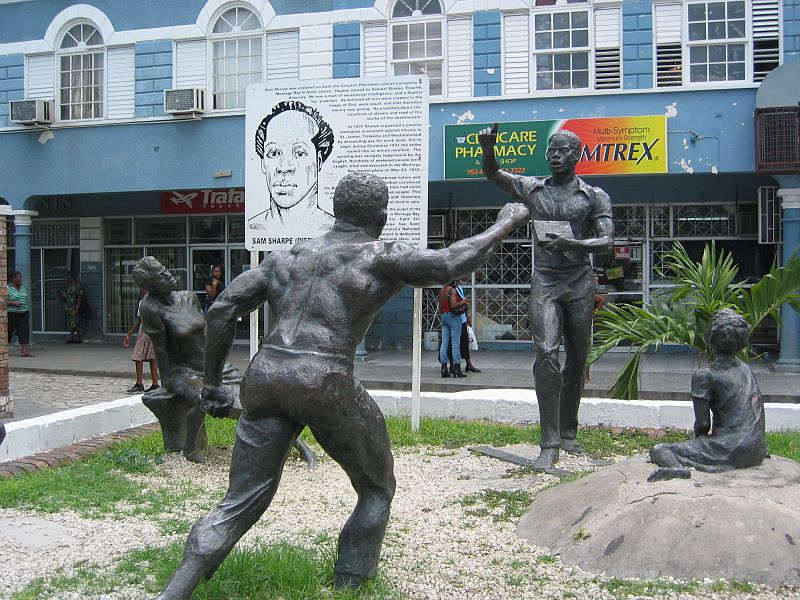
 "I would rather die in yonder gallows, than live for a minute more in slavery."~Sam 'Daddy' Sharpe
 Mek ah tell yuh, despite and in spite of the tendency of history to downplay the revolting slaves, we need to educate the masses that our freedom wasn't simply handed to a grovelling, begging people. I and I must uphold the memory of our martyrs of the African Holocaust. Throughout the region, thousands of slaves and maroons rebelled, revolted, fought and died for freedom leading up to Emancipation- Jamaica by far having the most documented rebellions. There were literally hundreds of rebellions in the West Indies. Some that have captured my imagination: The Haitian Revolution, Jamaican Maroon Wars, 1763 Revolt in Berbice (Guyana), Dominican Maroon Wars, Suriname's Maroon Wars, Tacky's Rebellion, 1733 Slave Insurrection (St. John, V.I.), Black Carib Revolts, to name a few.
In the british West Indies, though, there are three significant, large-scale rebellions that affected Emancipation that must be noted: Bussa's Rebellion (in 1816, Barbados), The Demarara Rebellion ( of 1823, Guyana), and Sam Sharpe's Christmas Uprising*** (1831, Jamaica). For sheer size and effectiveness in communicating to britain that slavery must go at any cost, they are most influential. 10,000 slaves revolted in the Demarara Rebellion and up to 20,000 in the Christmas Uprising, burning down cane fields and property, causing the equivalent of hundreds of millions of pounds in today's british currency. These three were pivotal in speeding up britain's inevitable decision.

I am appealing to writers and authors, songwriters and storytellers and wordsmiths: it is our duty to tell our story and educate the youth from our own perspectives. We cannot expect history to reflect ourstory and view point. If upcoming generations don't learn and appreci-love our collective stories and culture, we have only ourselves to blame. Especially in this age of information.


* predials, which were "field slaves", were to be apprenticed until 1940; nonpredials no later than Aug. 1, 1938 
** the total compensation paid out was £20 million which was 40% of the british government's total annual expenditure
***AKA the Baptist War, Sam Sharpe's Rebellion, and The Great Jamaican Slave Revolt


These countries observe August 1 Emancipation Day

  • Saint Lucia
  • Barbados: Emancipation Day in Barbados is part of the annual "Season of Emancipation" which runs from April 14 to August 23. The Season, includes the anniversary of the Slave Rebellion led by the Right Excellent Bussa, National hero, in 1816 , National Heroes Day on April 28, the Crop Over Festival,the Day of National Significance on July 26(in commemoration of the social unrest of 1937)and International Day for the Remembrance of the Slave Trade and its Abolition on August 23. Emancipation Day celebrations usually feature a Walk from Independence Square in Bridgetown to the Heritage Village at the Crop Over Bridgetown Market on the Spring Garden Highway. At the Heritage Village, apart from a concert, there is also a wreath-laying ceremony as a tribute to the ancestors. Traditionally, the Prime Minister, the Minister responsible for Culture and representatives of the Commission for Pan African Affairs are among those laying wreaths.
  • Bermuda: Celebration usually occurs on August 2, despite August 1 being the national holiday. On the island the holiday is better known as the first day of "Cupmatch", an annual two-day cricket competition between the St. George's and Somerset cricket clubs.
  • Guyana
  • Jamaica
  • Saint Vincent and the Grenadines
  • Trinidad and Tobago
  • Turks and Caicos Islands

These countries observe Emancipation Day the first Monday as August Monday

  • Anguilla: In addition to commemorating emancipation, it is the first day of "August Week", the Anguillian Carnival celebrations. J'ouvert is celebrated on this morning, as Carnival commences.
  • The Bahamas: Celebrations are mainly concentrated in Fox Hill Village, Nassau, a former slave village whose inhabitants, according to folklore, heard about their freedom a week after everyone else on the island. There is a also a celebration beginning on August 1 and lasting several days held in the charming settlement of Hatchet Bay on the Bahamian island of Eleuthera known as the Bay Fest.
  • British Virgin Islands: The first Monday, Tuesday, and Wednesday of August are celebrated as "August Festival".
  • Saint Kitts and Nevis: The first Monday and Tuesday are celebrated as "Emancipation Day" and also Carnival in Nevis.


Enhanced by Zemanta

Thursday, April 21, 2011

Rodney Reasoning


©2011 K.Omodele
 
It’s 12:35 p.m. one damp April day in Lower Manhattan. The Malone Construction labor crew’s collective spirit seems subdued by the gray, spring-time air. They slowly crumple up paper bags; dispose empty plastic bags and bottles, while palavering away the rest of their lunch break.
Rudeboy braces his back against a steel column, digging his gums with a toothpick. “Yow. Mi see di Vibez Kartel lecture at UWI* pon Youtube the other night. Maddd!”
Spence, the three-week-new laborer on the site, pulls down his specs and looks up at the six- plus, stick-thin youth.
“When yuh say ‘maddd’, wha’ you mean?” Spence asks, raking work-bent fingers through his steel-wool, smoke-white ‘fro.
Rudie removes a Newport from behind his ear, relights it and sucks the smoke into his magga** chest cavity. “Then, you nuh see how the man handle the UWI crowd? Intelligent and smooth…stylist,” he replies, a river of smoke winding around his words.
Bajie pours the remnants of coffee from his Thermos, and then authorizes himself into the reasoning like some member of parliament. “Finally, you and me can agree on something, Rudeboy. He surprised me. He actually held a decent position, though I wouldn’t exactly call that intelligent.”
“Wha’ you woulda call it, then?” Rudeboy gestures in the air with his cigarette like a music conductor. “How many entertainers you know that coulda hold their own inna that kinda university lecture setting?”
Dreadie, forever a voice of reason, throws in his two shillings. “Rudie, Kartel mek a mockery of the academic platform. A UWI lecture? That suppose to be serious. Wha’ yuh seh, Trevor? You see it?”
Trevor guzzles the last of his water, rumble belches then says, “The man treat the whole thing like a self-serving, press conference. And mek it worse, he tried tie-in Marcus Garvey and Walter Rodney.”
Dread shakes his forefinger. “Yuh catch that? When he said ‘Sir Walter Rodney’?”
Rudeboy bull-rushes in with an interjection. “And wha’ happen to that?”
Dreadie whips out a hand-kerchief and waves it like a matador at Rudeboy. “Is Doctor Walter Rodney. Not Sir.”
Spence adds. “Kartel mussy confuse Walter Rodney with Sir Walter Raleigh.” Chuckling. “How you fi confuse the Brother, di Comrade, professor of African studies with a ole pirate.”
The whole crew cracks up, even Rudeboy.
At precisely 1PM, they grab their helmets and drag themselves into the building.

It’s now around 5:15 and the crew is trudging up Broadway toward the Park Place subway. Each man is seeking the no. 2 train, destination: Flatbush. ‘cepting Bajie of course, who, true to his contradictory form, is the only one catching the E to Queens.
Spence continues the reasoning from earlier. “Y’know, Rodney’s legacy LARGE when it come to the University… graduated there; taught there. As a matter of fact, when Hugh Shearer kick him outta JA, is the UWI students first tek up protest. And is that protest lead to the Rodney Riots in ‘68.”
Rudeboy now looks puzzled. “The government kick him out? Fi wha?”
“Actually, they barred him from coming back into Jamaica,” Bajan says. “Sent him right back to Guyana. Is Trevor them homeboy.”
Spence cut his eyes at Baj. “Kick him out beca’ they label him the single greatest threat to Jamaican security at that time.” Realising he is commanding Rudie’s full, yet confused attention, he continues. “See, Rodney taught African history. Plus he preached bout Black Power and was a Garveyite, which scared the hell outta them. Then he was a Marxist that chastised Capitalism and classism.”
Dreadie injects. “So you know that had them paro .”
“Hold on, now!” Bajie stops them. “Garvey was a capitalist. Rodney was a socialist. How in the hell he gon be a Garveyite?”
“How yuh mean? Is not me say so! Rodney proclaim himself a Garveyite. And in any case Garvey dealt with community and Rodney with Communalism.” Spence answers. “Anyhow, Rudie, they labeled him a subversive element when di man come venture down inna the ghettoes and gullies, talking with poor people and reasoning with Rasta youth. Rudebwoy, yuh need to read Groundings With My Brothers.”
Rudeboy nods. “I seen it.”
“Yuh read it?”Dreadie asks.
“Ehn-enh. But I know them kill him down inna Guyana, right?” Nodding at Trevor.
Trevor clears his throat. “Yeah man. Is like a Malcom X type ah thing. His own matty Black brother kill him. Boom him up.”
They reach the subway entrance .
Dreadie adds. “The President of Guyana himself-Burnham, order the hit!”
Before they descend down underground and part ways with him, Bajie smirks. “I surprised you didn’t claim the C.I.A. Oonu*** damn conspiracy theorists.” He runs down the steps taking two at a time and heads for the Uptown side.
Spence cries out. “Cho! But then who yuh think sanction it? Nuh di C.I.A.? Is them behind all the political fuckery back in them days. All up to now!”
The rest of them swipe their cards, and as they make way down to the Brooklyn side, Dreadie nods in approval.
“Yeah yuh right. But yet still, Burham had it out for him.”
They reach the platform. Up the platform towards the escalator, three youths gang up on a fourth, beating him down. The construction crew looks on as the gang pulverizes the helpless boy, slicing his face with a box-cutter.
“One thing for sure though, Rodney influence Rasta in nuff a them small Eastern Caribbean islands. Notice how them Rasta deh in Grenada militant, bad. They all help overthrow Gairy. Is Rodney that. Everywhere that man went, when he see the establishment oppressing and victimizing the poor, he sound out against it.” Trevor responds.
But everone is now focused on the scene up the platform. 
Trevor continues, as he begins making his way toward the ruckus. “That’s why nuff government couldn’t stand him. They ein’t want no talk of revolution. And besides, the Cold War was being fought right down there in the West Indies- Cuba, JA, GT, Grenada. We ein’t stand a chance, bout we aligning weself with either one a them Super Powers.”
Dreadie declares, “Vampires. Babylon them!” and unsheaths a hammer while stepping up the platform.
“True! The whole a them.” Spence says. He grabs a screw driver from his utility belt.
The construction crew picks up pace. Burst into a rush up the platform, drawing tools from their bags and utility belts as their train rumbles toward them in the distance.
The clack-clack of the train riding the track grows louder.
The platform vibrates.

*University of The West Indies
** extremely slim, skinny
***you, you all


Thursday, November 12, 2009

The Under The Mango Tree


©2009 K.Omodele
In Nineteen Eighty, poor people couldn’t stop talking bout young Natty Fidel and the newspapers couldn’t stop writing about him. The capital city was a barrel of gun powder with a slow-burning fuse, and the people of the city squeezed their eyes tight and corked their ears.
The Under The Mango Tree was little more than four gray, cinderblock walls, with a fifty-five gallon drum grill planted outside the back door. Inside was a vinyl covered bar counter with a sink behind it. In one corner, a beatup jukebox offered 45’s, selections from an era that had slipped away-the time of Desmond Dekker, Sam Cook, and The Mighty Sparrow. Overhead, a bare forty-watt bulb with a pull chain hung precariously, a threatening hangman’s noose.
A ruby glow snaked from behind the counter where the owner was bent over stocking the freezer chest with beer and stout and Malta. She pretended to ignore the two plain-clothes regulars huddled at a table by the juke box. She was a single mother of two and still attractive in her early forties. Her hands and feet were calloused and her heart tattered by pieces of shattered dreams.

Mid-day approached and she methodically prepared for the after-work, happy hours. Friday evenings were typically her busiest. The bar was a skip and jump from the city’s East-side police station and so it was like an officers' clubhouse. And so, in the surrounding ghettos it was known as the “Babylon Bar”.
Rising from the freezer, the owner wiped her hands on her apron and scooped up two plastic containers on the way out the back door. A minute later, spices dripping on embers sizzled and popped. Roast fish aroma wound through the door tantalizing the two men drinking at their table.
“Ms. Lorna,” shouted the older one-the detective sergeant. “I telling you, your hand coulda resurrect Christ. I need two piece a fish.”
“Coming deh, Mr. Pruitt.” This one was a killer, f’real. He was manatee large and deliberate in his movement. When he explained things, his voice was bogged in impatience.
Ms. Lorna scurried back outside and in few seconds flashed back behind the counter with two fire-hot fish in brown paper.
“And bring a next round,” the younger detective added, waving a long arm. He was a light post with a razor-bumped face.
Miss Lorna answered. “No problem!” and threw a pan of ice in the sink behind the counter. She ice-picked it and fixed two more rum and coconut water. Tossed a splinter of ice in her mouth, savored the coolness, and dabbed her forehead and neck with her handkerchief. Then she pressed her lips into a smile and went over to serve them their fish and drinks.

“So, where in the hell this little careless girl could gone?” the detective sergeant was inquiring. “Must be with the boy.”
Lorna placed the fish, then the drinks on the table and cleared the empty glasses.
The younger man snatched his glass and swirled the drink around. “She mussy left Town and gone out to the country.” He removed his nine-millimeter from his side and thrust it beside his food and drink.
Lorna wrapped a glance around gun and shuddered. Flashed a plastic smile then spun on her heels. As she retreated to the counter, she could feel the young detective’s eyes burning her backside.
“Is a week now nobody see this girl? You think she with the boy?” she heard Detective sergeant Pruitt ask. Before the young detective could answer, Pruitt slammed his hand on the table, jumping the man's gun . “Damn these hooligans! Running ‘round town like some leggo beast. I’m telling you Owens, is the politicians making them feel like they important. Me and you know where the guns coming from.”
Young detective Owens nodded in agreement. He stroked his gun metal and could barely conceal a twinkle in his eye.
Pruitt continued. “You can believe this? The gangs, they have better artillery than we. And still, the police force supposed to clean up this mess?"
Smirking, Owens leaned toward his supervisor and lowered his voice.
“Mr. Pruitt, I know where the boy going tonight,” he said, and then leaned back smugly.
Pruitt’s eyes riddled holes through him.
Behind the counter, Ms. Lorna strained her ears and threw her eyes down on a spot on the floor...

">(To be continued)


Related Posts Plugin for WordPress, Blogger...

Featured Post

Spoken Word Griots: African Oral Tradition in Caribbean Music (Third Part) - Calypso

Spoken Word Griots: African Oral Tradition in Caribbean Music (Third Part) - #Calypso by K. Omodele African traditions and customs are i...

Popular Posts