Related Posts Plugin for WordPress, Blogger...
Get Our Free Newsletter
Showing posts with label slavery. Show all posts

Wednesday, January 30, 2019

Abeng Essay: The Beginnings and Development of Racism in The U.S.: Some Implications for Black Americans (Part 2) by Dr. Cicely A. Rodway


The Beginnings and Development of Racism in The U.S.: Some Implications for Black Americans (Part 2) by Dr. Cicely A. Rodway copyright 1987 C. A. Rodway


"To fully appreciate the long history of white racist views which have had such negative effects on all aspects of Black Americans' existence, it is necessary to begin at the very beginning when the first [Africans] were brought to America from the Motherland, Africa." ~ Dr. C. A. Rodway; from part 1 of this essay 


The first Africans were brought to America in 1619 by a Dutch captain and left in Jamestown, Virginia. At this point in history, Blacks were viewed as simply another aspect of the many-sided economic problems which the white colonists were called on to face. (Jordan, 1968) The colonists gave very little attention to the status of the slaves who were treated similarly to white indentured servants and enjoyed the same status. Therefore, up to 1651, at the end of their service, black indentured servants were "assigned lands in much the same way as was being done for white servants." (Jordan, 1968)


This situation soon changed as the colonists, faced with an unlimited supply of land, needed labor to utilize it. The colonists grew tired of replacing indentured servants whose period of service had expired. They were also faced with the failure of their attempts to use Indian slave labor. The colonists quickly saw a way by which they could solve all their problems at "one fell swoop."

The problem could be solved by placing the negro in "perpetual servitude," which would solve the problem of finding replacements, as there would be an "inexhaustible supply" of Negroes. (Jordan, 1968) This purely economic decision marked the advent of the slave trade in America. It began gradually, but begin it did for by 1640, when Negroes were brought into the country they were no longer given "indentures or contracts and could not look forward to freedom after a specified period of service." (Jordan, 1968) But, it was not until 1661 that there was a statutory recognition of slavery. However, despite the new slave laws, no attempt was made by the colonists to enslave or change the status of the indentured servants who had completed their period of service and were free to live as the chose in Virginia.

This chain of events in Virginia was more or less mirrored in the occurrences in the other Southern colonies, in New York, New Jersey, Pennsylvania and Delaware. By the end of the 1660's, negro slavery was a "fait accompli" in the settled parts of America. There were degrees of harshness in the treatment of slaves and in the attitudes of the colonists toward slavery, as was evidenced by the actions of William Penn in Pennsylvania and the Quakers in New Jersey. Despite this, the final and incontestable fact was that negro slavery had been institutionalized and legalized and was an accepted status for negroes. This was to continue as an accepted part of the fabric of American life until 1865.

How Did Christians Rationalize and Justify Slavery?

It may seem ironic that this new "Christian" country whose stated
basis for establishment was individual freedom and whose enunciated doctrine was built on the "essential equality of all men," (Franklin, 1847) could be involved in the slave trade. The Bible had spoken unequivocally against the evils of slavery and had condemned slave owners. In Exodus 21:16 it was stated, "And he that stealeth a man and selleth him, or if he be found in his hand, shall surely be put to death." So, the colonists in an attempt to appease their consciences set about finding rationalizations for enslaving negroes.

Monday, November 6, 2017

Abeng Op-Ed: Are Many African-Americans Still Disconnected From Africa? by Joshua Chikudo

 Many Young African Americans Are Still  Disconnected From Their African Roots

                   By Joshua Chikudo August, 2017


"You Africans look like some of us African Americans" a young man accompanied by his girlfriend said to me as we waited for our beverages at a starbucks in South Florida. The statement caught me by surprise, how could somebody know I was African in a community full of so many  Caribbean immigrants. I had been mistaken for a Jamaican or Haitian in the past, but rarely called African American. I then remembered I had just finished telephone conversation with one of my African brothers before I placed the order. 

Now, the first thing that came into my mind was this African saying: "A father does not look like the son; it is the son that looks like the father". Since I have always enjoyed sharing the culture, politics and business knowledge of our African people and I have always assumed that African history or heritage is not taught in-depth at most American elementary schools, I was extremely eager to answer any questions the young couple had regarding Africa, our people and culture. I invited them to an empty table. My father always said there were no stupid questions in life, so I answered every question as best as I could.

One of the questions the young man posed was why so many different cultures existed amongst black people. Since the majority of African-Americans descended from the West African region, we can clearly see African culture in those parts of the United States where African Americans reside. And also, though African cultures vary, many share similar fundamental beliefs. But the slave era interrupted the continuity of culture when Africans were brought to America.


Though Europeans primarily orchestrated the slave trade, corrupt chiefs also played a significant role. Our communities were too welcoming which led to the success of the slave trade. The traders took advantages of our hospitality; our people were overpowered by better weapons and many of our strong men and women were forced into captivity in foreign lands


It is in these lands where their culture was altered to fit their masters' desires. The slave system ensured that our people lost contact with Africa. So much of African-American culture has European influence; however, if one looks deeper one can see some semblance of African culture within African America.

I was astonished when the young couple asked me why Africans believe in voodoo and if we believed in God. Many Westerners and Americans view African spirituality as evil. In Southern Africa many of us have always believed in the Higher power, The Almighty( Uthixo in Ndebele/Zulu, Mwari in Shona). Communities communicated with the higher power differently depending on the  specific culture.
Our ceremonies have been portrayed as voodoo by those who do not understand our practices. In many ceremonies we invite the spirits of our departed( Amadlozi in Ndebele/ Zulu, Vadzimu in Shona); we ask them for continual spiritual  guidance while relaying our prayer requests to The Most High.
Some people believe that African spirits can harm others by relaying bad energy to a targeted individual.(Ubuloyi in Ndebele/ Zulu, Kuroya in shona)

The first Europeans settlers that came to Africa did not approve of our worship. They introduced the Bible, their version of Christianity: God The Father was white, God's son Jesus was white, The Holy Ghost, too, was white. In their eyes everything had to be white to be pure.
These same people brought the idea that the devil Lucifer and our African beliefs were black and satanic. These views helped shape the African-American misconception of African cultures. Today Africa practices a variety religious beliefs; Islam, Christianity, Buddhism, Hinduism, Rastafarian and traditional African animism contrary to Western media portrays.

Our conversation had gone on for an hour before the young couple asked me a very complex question: Why Africa was so poor, undeveloped, backwards and full of diseases? Most African Americans I have met are taught to glorify white-American and European culture. Images have been implanted in their minds that Africa is back-wards and primitive. Media outlets fail to share the growth and progression taking place across the continent. 
Many subscribe to the propaganda that broadly paints African governments as corrupt dictatorships. While there are still a few corrupt and undemocratic regimes, the vast majority of Africa is now stable.

Africa has a young population that seeks the same peace, financial stability and security that younger generations in the West seek. African Millennials, like Millennials all over the world, are spearheading technological advances that are helping to diversify and globalize African economies.
Some of these young African inventors and innovators are helping to change people's lives in many positive ways. I recommend those who like to learn about some of the progressive innovations that the continent has taken to read Ashish Thakkar's " The Lion Awakes" which highlights some of the many advances occurring in the motherland. 

Africa has been responding successfully to disease outbreaks. Since the 2014 and 2016 Ebola Deadly virus in the West Africa which left 11300 people dead( Wall street Journal; July, 2017). With the help of the World Health Organization and other NGOs, western doctors and African personnel, Africa managed to contain the disease. Even when it resurfaced in Congo ( Kinshasa) Africans contained the disease. Diseases like Malaria, Tuberculosis are now controllable. When it comes to AIDS, people are more educated about safe sex, avoiding infection and and adhering to available medication.

I concluded our conversation reiterating that Africa has evolved and continues to better its communities. I let the young couple know that having members of their generation connecting with their heritage will indeed be a great asset to the continent.
If we can get some of these educated, professional Africans in the Diaspora to come home to empower communities with productive wisdom and technological knowledge, we can catch up with the developed world faster and be better sales people for the continent.

Mr Joshua Chikudo

Monday, February 15, 2016

Black History: The Haitian Revolution (The Revolt That Birthed a Nation-Part I)

  Black History: The Haitian Revolution (The Revolt That Birthed a Nation-Part I)
                                          by K. Omodele 2016 @TheAbeng

Introduction- Slave Revolts In the African Diaspora
There have been hundreds of slave revolts in the history of the African Trans-Atlantic slave trade. Africans resisted captivity in slave forts, on ships and plantations. In St. John and Guyana, slaves took over whole colonies, tasting freedom temporarily, before being re-conquered and re-enslaved.* Maroons in Jamaica, Surinam and Brazil, and Black Caribs in St. Vincent, fought colonial masters and militias to establish independent/sovereign societies that existed autonomously within individual slave colonies. However, the slave insurrection that is distinctive in achieving an ultimate level of success (freeing the whole slave colony AND forming an independent nation) is the epic Haitian Revolution.

"The revolution is made by ordinary people, not by angels, made by people from all walks of life." ~ Dr. Walter Rodney

The Haitian Revolution was the most successful slave revolt in the history of the so-called New World (i.e. The Western Hemisphere). This revolution significantly affected dynamics in the histories of the West Indies, both Americas, the African Diaspora and Europe. Its events gradually formed a nation, but the revolution's leaders didn't learn their tactics in military academies studying the art of war or political science; nor were they propagating a new economic system or faith. These revolutionaries emerged off fields and fled plantations, first brandishing cutlasses, machetes, hoes and fire; then, with guns, cannons, more fire and cries of freedom, they executed revolts that became a revolutionary war that gave birth to Haiti** - the second independent republic in the Americas and the first nation formed by former African slaves.

Saint Domingue In The 1700s
In 1697, Spain ceded the Western third of Hispaniola to France. The Spanish called their colony Santo Domingo, the French called theirs Saint Domingue. In the 1700s, Saint Domingue was the most prosperous colony in the world and the richest in the entire French Empire. Africans slaved on highly profitable plantations where sugar was the chief crop, but others included tobacco, coffee, cocoa, indigo and cotton. By the end of the century, estimates have the population in Saint Domingue at:

-  30-40,000 Frenchmen (grand blancs and petit blancs)
-  22-27,000 Mulattoes and free Blacks (gens de coleur)
-  500,000+  Black/African slaves

"Nowhere in the West Indies in 1789 was there a greater hell on earth than the French Colony of Saint Domingue..." ~ Dr. Eric Williams
These various classes/castes within the society resented, often despised, each other. Being outnumbered over 10 to one, the Frenchmen, the plantation owners, were constantly on edge to hold on to the balance of power and so kept their African slaves in line by brutalizing them for slight offenses and beheading and racking them for insubordination. But these Whites themselves were divided by class: the grand blancs were the planters and merchants, while the petit blancs were the lower-class workers and laborers.
The Mulattoes and free Blacks had the right to own property but resented the fact that they had little or no legal rights.
Of course, slaves had no rights and so they despised the other classes.

*some leaders and members of these rebellions committed suicide rather than be taken alive and forced back into slavery.
** Haiti ~ Ayti was the Taino Arawak name for the island Columbus "claimed" for Spain, calling it Hispaniola (present-day Haiti and the Dominican Republic. Ayti ,means "Land of high mountains"

The Haitian Revolution Part 2 - Leaders of the revolution: Boukman, Touissant, Dessalines, Christophe, et.al.

References:
Fick, Carolyn E. The Making of Haiti: The Revolution from Below. Knoxville, Tenn., 1990.
James, C.L.R. The Black Jacobins: Touissant L'Ouverture and the San Domingo Revolution. 1938. Reprint. New York, 1963.
Williams, Eric. From Columbus to Castro- the History of The Caribbean 1492-1969
Williams, Eric. History of the People of Trinidad and Tobago. Reprint.

Monday, August 1, 2011

Saluting Emancipation Day

Bless up this Emancipation Day/August Monday!
Someone special just mentioned to me that
We need some new teachers, or to evolve into the elders we are lacking/silencing. The statement is drenched in relevance- we are doing a terrible job in educating generations about our own culturally poignant history. We celebrate all manner of so-called holidays (many that are nonsensical and perpetuate lies), branding ourselves with other cultures' values and mores, while displaying little regard for our own culture and what we have overcome as a people. Jah Know!
It is I and I's (our collective) responsibility to tell ourstory, since we know history is his story and our half has hardly been told. For instance, this Tarzan-like partiality is plain when in history much praise is lauded towards the contributions of various british anti-slavery societies and organisations while relatively little importance given to the thousands of freedom fighters/slave revolts in the Caribbean region. Is full time now our story be told by us on a wider scale.

babylon release the chains...
On August 1, 1834, The Slavery Abolition Act of 1833 not-so effectively abolished slavery in the british vampire (ok, since yuh/oonu/wunna/awyuh tek offence, british Empire then). Each slave younger than six years old was "officially" declared free. But practically, this emancipation was quasi-freedom and slaves weren't actually freed until August 1, 1838.

but dem a use dem brains...
I say "not-so effectively" because if you overstand how this emancipation played out, you'd know that it wasn't like britain just let go of cheap labor without covering its arse. The jolly-good boys dem brought in a system of apprenticeship in which slaves older than six years actually worked  for four to six* more years to ensure planters would have labor and that plantation economies wouldn't belly up after emancipation. This "apprenticeship" was designed to keep slaves working eighteen hours a day on plantations in return for food, clothing and shelter while labeling them as "free".
And a next thing, millions of pounds** were given to slaveholders as compensation for losing their "property", while no money was given to slaves themselves. This systematically ensured that most ex-slaves would remain on a lower economic tier, dependent on their ex-masters for wages and livelihood.
East Indians and Chinese soon began being imported to the Caribbean as indentured servants to fill the void left after Blacks left the plantations. In many cases, these Asians would be housed in old slave quarters. 

more ourstory
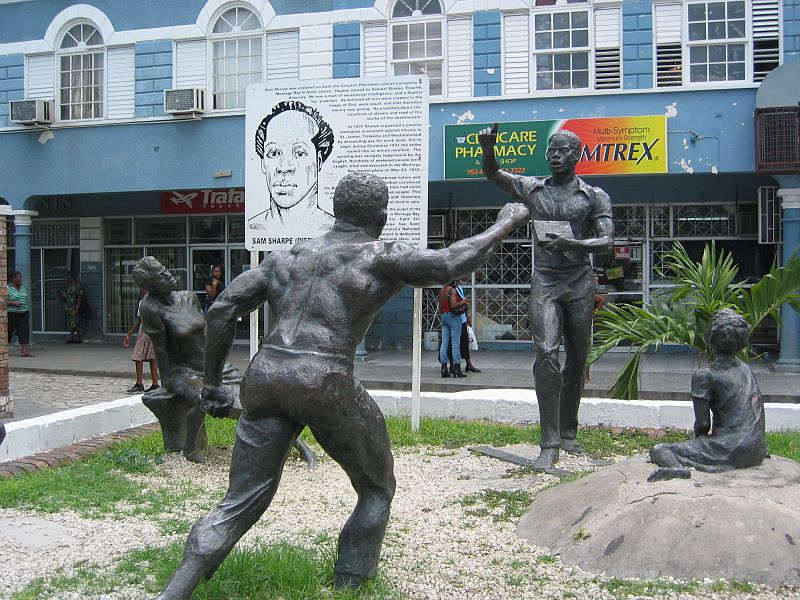
 "I would rather die in yonder gallows, than live for a minute more in slavery."~Sam 'Daddy' Sharpe
 Mek ah tell yuh, despite and in spite of the tendency of history to downplay the revolting slaves, we need to educate the masses that our freedom wasn't simply handed to a grovelling, begging people. I and I must uphold the memory of our martyrs of the African Holocaust. Throughout the region, thousands of slaves and maroons rebelled, revolted, fought and died for freedom leading up to Emancipation- Jamaica by far having the most documented rebellions. There were literally hundreds of rebellions in the West Indies. Some that have captured my imagination: The Haitian Revolution, Jamaican Maroon Wars, 1763 Revolt in Berbice (Guyana), Dominican Maroon Wars, Suriname's Maroon Wars, Tacky's Rebellion, 1733 Slave Insurrection (St. John, V.I.), Black Carib Revolts, to name a few.
In the british West Indies, though, there are three significant, large-scale rebellions that affected Emancipation that must be noted: Bussa's Rebellion (in 1816, Barbados), The Demarara Rebellion ( of 1823, Guyana), and Sam Sharpe's Christmas Uprising*** (1831, Jamaica). For sheer size and effectiveness in communicating to britain that slavery must go at any cost, they are most influential. 10,000 slaves revolted in the Demarara Rebellion and up to 20,000 in the Christmas Uprising, burning down cane fields and property, causing the equivalent of hundreds of millions of pounds in today's british currency. These three were pivotal in speeding up britain's inevitable decision.

I am appealing to writers and authors, songwriters and storytellers and wordsmiths: it is our duty to tell our story and educate the youth from our own perspectives. We cannot expect history to reflect ourstory and view point. If upcoming generations don't learn and appreci-love our collective stories and culture, we have only ourselves to blame. Especially in this age of information.


* predials, which were "field slaves", were to be apprenticed until 1940; nonpredials no later than Aug. 1, 1938 
** the total compensation paid out was £20 million which was 40% of the british government's total annual expenditure
***AKA the Baptist War, Sam Sharpe's Rebellion, and The Great Jamaican Slave Revolt


These countries observe August 1 Emancipation Day

  • Saint Lucia
  • Barbados: Emancipation Day in Barbados is part of the annual "Season of Emancipation" which runs from April 14 to August 23. The Season, includes the anniversary of the Slave Rebellion led by the Right Excellent Bussa, National hero, in 1816 , National Heroes Day on April 28, the Crop Over Festival,the Day of National Significance on July 26(in commemoration of the social unrest of 1937)and International Day for the Remembrance of the Slave Trade and its Abolition on August 23. Emancipation Day celebrations usually feature a Walk from Independence Square in Bridgetown to the Heritage Village at the Crop Over Bridgetown Market on the Spring Garden Highway. At the Heritage Village, apart from a concert, there is also a wreath-laying ceremony as a tribute to the ancestors. Traditionally, the Prime Minister, the Minister responsible for Culture and representatives of the Commission for Pan African Affairs are among those laying wreaths.
  • Bermuda: Celebration usually occurs on August 2, despite August 1 being the national holiday. On the island the holiday is better known as the first day of "Cupmatch", an annual two-day cricket competition between the St. George's and Somerset cricket clubs.
  • Guyana
  • Jamaica
  • Saint Vincent and the Grenadines
  • Trinidad and Tobago
  • Turks and Caicos Islands

These countries observe Emancipation Day the first Monday as August Monday

  • Anguilla: In addition to commemorating emancipation, it is the first day of "August Week", the Anguillian Carnival celebrations. J'ouvert is celebrated on this morning, as Carnival commences.
  • The Bahamas: Celebrations are mainly concentrated in Fox Hill Village, Nassau, a former slave village whose inhabitants, according to folklore, heard about their freedom a week after everyone else on the island. There is a also a celebration beginning on August 1 and lasting several days held in the charming settlement of Hatchet Bay on the Bahamian island of Eleuthera known as the Bay Fest.
  • British Virgin Islands: The first Monday, Tuesday, and Wednesday of August are celebrated as "August Festival".
  • Saint Kitts and Nevis: The first Monday and Tuesday are celebrated as "Emancipation Day" and also Carnival in Nevis.


Enhanced by Zemanta

Thursday, April 7, 2011

Sound The Abeng!

Copyright 2011 K. Omodele

 
A youth ask me the other day why I chose the word "ABENG" for this blog.
Wha' it mean? A wha'?
Abeng is ah animal horn* in the Twi language of the Akan people of Ghana. It traveled 'pon slave ships in the heart and minds of a captured people and survived with them through the horrors of Maafa** just as many aspects of culture did.
So is ah instrument, then?
Yeah man. Maroons*** in Jamaica used to sound di Abeng as a signal during the Maroon Wars against the English, who were determined to re-enslave them.
Eh? Wha yuh mean ‘sound di abeng’?
The Maroons set up camps and towns, in the hills in the East and in the Cockpit Country, and had sentries posted to warn of any threat, any approaching attack. The sentries them would literally sound di Abeng, blow it and communicate warning with other Maroon villages.
So, was  like ringin alarm? To Rass!
Yeah man! Is a symbol of freedom. Sounding di Abeng is a declaration of liberty, yuh overstand?
SOUND DI ABENG!

*most often cow
**African Holocaust of slavery
***freed and escaped Africans


Copyright 2011 K. Omodele


Enhanced by Zemanta
Related Posts Plugin for WordPress, Blogger...

Featured Post

Spoken Word Griots: African Oral Tradition in Caribbean Music (Third Part) - Calypso

Spoken Word Griots: African Oral Tradition in Caribbean Music (Third Part) - #Calypso by K. Omodele African traditions and customs are i...

Popular Posts